
Showing posts with label archaeology. Show all posts
Showing posts with label archaeology. Show all posts
Saturday, June 15, 2019
Monday, August 27, 2018
Guys, seriously... what am I doing with my life?

First of all, I'd like to apologize for not updating this blog in a while. I have a lot of ideas for new content and various topics that I'd like to cover... but I've just been so busy or exhausted that I haven't had time to write the sort of detailed and informative articles that I consider of a high enough quality to post. So it's not that I'm out of ideas. I never have writer's block or artist's block. I'm just too dead inside.
And now I'm going to do something I usually never do on this blog... talk about myself. I mean, I usually post serious articles about history or politics or at least something slightly serious like art/short stories/book reviews... but I never talk about myself. So how about I do a deep feelsy post
E X P O S I N G myself in front of the whole world?
I don't even really know where I'm going with all this, but we'll see...
So first of all I have to say that I've been under a lot of stress and that's mainly academic stress. I'm about to go into grade 12 in September (senior year for any Americans reading this) and it really fills me with worry and dread for the future. Basically, if I don't get good grades this year I'll kinda die. I don't want to be homeless and live in a barrel even though I admire Diogenes. And also, I have no idea what I want to do with my life. My dream is to be a writer but of course my parents aren't a fan of this idea, just like any good parent should react to a child who wants to go down the starving artist path.The highlight of my summer was going to a real archaeology field school and helping to excavate a 600 year old village built by an Iroquian speaking group who were probably the ancestors of the Wendat (I know I know, you're all probably like OMG WHAT? WHEN WILL YOU TELL US MORE? Well I promise I'll do lots of detailed posts about everything I learned there later... but for now let me rant.) All the other students there seemed so legit and had their act together. Many of them wanted to go into archaeology, history or indigenous studies at Trent University. And then there was me. I mean, I love history to death (I run a nerdy history blog, remember?) but I don't know if I'd want to pursue a career in it. I have stereotypical brown parents that want me to do the doctor/lawyer/engineer thing and all my IRL friends want to go into STEM fields.
Also, I feel like I have a right to say this because I excel in arts and humanities related subjects... they all suck.

Seriously who would you save? Even if you have a PHD in classics from Oxford I'm sure you'd rather save the STEM majors because they contribute so much more to society.
But i suck at math so i guess i'll die
Everyone who knows me well knows that there are three things that I love: history, philosophy and linguistics (including the English language and all the literature and stuff that it includes). And who are we kidding, these fields are all useless to humanity. I know someone who is doing a PHD in linguistics and is relying on food banks. No one cares about what people like that do and I don't think you can blame them for not caring.
Have you ever heard an engineering major brag about how smart they are? well even though I hate it when they do that, I have to admit they are 100% justified in doing so. Because anyone can learn Latin, analyze literature, or understand weird ideas written by dead philosophers but it takes a special type of smart person to do whatever it is that engineers do.
Is there any way I can study something I'm really passionate about while still satisfying my parents and societal expectations?
Maybe I might get into the University of Toronto or McMaster by some sorcery into a health science program and become a doctor and then quit at some point to become a historical fiction novelist like my dreams but that's not possible.
WAIT A MINUTE
This might be the answer to my prayers
So recently I've come across the Arts & Science program at McMaster which seems really prestigious because they require an 88% average which includes Calculus, Advanced Functions and English as well as a great supplementary application proving that you contribute a lot to the community with volunteering or extra curricular programs. It only accepts 60-70 students a year!!!!!! I CAN DrEAM.
I just really love the idea of it because it's like an "undecided major" program because it's great for people who have commitment issues like I do and can't imagine limiting ourselves to one field. Finally, I can take classes in both physics and philosophy. But IDK if I'll actually get in.
They should really make more arts programs that have high admission requirements instead of just a 75% average and portfolio like most of them do. That will teach people some respect for arts majors.
ok that's all
#rantover
Monday, August 6, 2018
Cool Prehistory Stuff
Have you ever wondered how long people have inhabited the Americas for? I don't know about you, but it's the kind of question that keeps me up at 3 AM.

It seems that new archaeological discoveries keep on pushing the date back for oldest permanent settlement in the Americas. For a long time, a discovery at Clovis, New Mexico in 1932 caused people to agree that the earliest settlements in the Western Hemisphere were established around 13,000 years ago. In 2011 however, the Buttermilk Creek complex in Salado, Texas was discovered. This paleolithic settlement was found to be 15,500 years old.
These incredible discoveries were not only made in the southern United States. On Triquet Island, just off the coast of British Columbia and north of Vancouver Island, a 14,000 year old village was excavated in 2017.
Alright, so we know that the first settlements in the Americas were way older than 13,000 years.
Some people may wonder, were the people who lived in these paleolithic settlements genetically related to modern Native Americans? I mean, our automatic assumption would be yes. But it was important to still find some concrete evidence to dispel any ridiculous pseudo-historical myths circulating about how these first inhabitants were the Lost Tribes of Israel or... Solutreans (yes there are actually some people who think Europeans from the Iberian peninsula crossed the Atlantic 26,000-19,000 years ago).
Crossed the Atlantic?



Some good sources for further reading:
If you want to read my rant about how much I hate pseudo-history, Check out this post I wrote back in 2017 . For now, lets focus on facts.
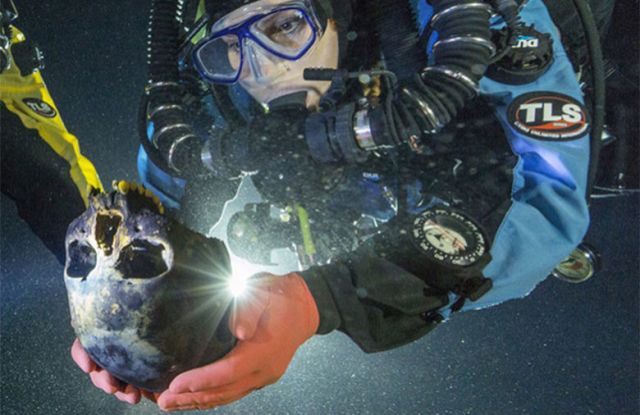
This next discovery is very important. In 2007 the 13,000 year old skull of a female teenager was found in an underwater cave in Mexico and was given the name "Naia" (a clever Greek mythology allusion). DNA tests were done on Naia, and from this it was concluded that the results matched with modern Native Americans. Well, that's just one example, but many other DNA tests from other parts of the continent have come up with the same conclusion. We need to stop denying Native Americans their ancient heritage. It's time to end racist and damaging pseudo-history. Here's a post I wrote a long time ago about the facial reconstruction of an Ancient Peruvian Queen that seemed somewhat relevant.
So for the remainder of this blog post, I'm going to continue pondering the questions when did the first people get here and how did they get here? Neither question has a definite answer, but it's fun to research the possibilities. Perhaps someday archaeology will uncover the truth.
3 million years ago, way before there were any people anywhere, an isthmus formed that connected North America and South America. This is everyone's favourite isthmus now, Panama.
During the recent Ice Age, about 1.8 million years ago, glacial advances covered up most of the northern extent of the continent. This caused worldwide sea levels to lower as water became locked in the ice sheets. So, vast amounts of land sprung up that are now submerged under higher water levels. One of these land masses was Doggerland, which connected northern Europe and the British Isles.
But everyone's favourite now-submerged landmass was of course Beringia.

Beringia Refugium
The theory goes that Beringia was a large shelf between Alaska and Siberia. It was nearly continent-sized. It also wasn't glaciated! This means that there were actually vast grasslands on Beringia capable of supporting herds of animals. This is what gave it the name "beringia refugium" as it was like a refuge for these creatures who could not survive in the glaciated areas. Lots of animals crossed over this land bridge, as well as people. These people migrated across Beringia at least 20,000 years ago and no earlier than 50,000 years ago.


Creatures of Beringia Refugium
- Ancestors of the modern horse, which would then go completely extinct until Europeans reintroduced horses.
- Ancestors of camels, which evolved into llamas.
- The longhorn bison
- Huge beavers

bEwArE!
The crossing of people across Beringia would have been a leisurely and slow one. People would have moved to follow the big game herds. As mentioned earlier, this crossing could have occurred any time after 50,000 years ago and probably before 25,000 years ago. That answers the very first question posed of how long Native Americans lived here, but how they got here still hasn't completely been answered.
Let me explain, of course the Bering Strait theory is the most credible theory we have and it has lots of scientific proof, but people have also suggested an alternate theory (or one that could have occured after Beringia): water craft.
If you don't think people 25,000 years ago could have invented water craft, think again because the Australian aboriginals got to Australia by boat 50,000 years ago from Africa.
But now there's a bit of a problem...
Because you see, we still don't know how people crossed into the interior of North America, beyond the glaciers. Some have suggested that a corridor opened between the glaciers originating in the Rocky Mountains and the ones from Hudson's Bay. Others have countered that and said that if a corridor really had opened up, the environment would be too harsh to allow crossing. So here the water craft theory comes in again.
Clearly, people need to look more into this so that these mysteries can be solved.
But some how, we know that indigenous people definitely spread as far as South America before 20,000 years ago. We can call this group the Paleo people as they migrated to the Americas during the last glacial episodes. By this time mass extinctions of all the weird animals I mentioned earlier started happening.
The Archaic Period
Around 9,500 years ago the Archaic Period began. Native people had to start adapting their way of life to a warmer environment. The Archaic Period ended around 2,900 years ago. Around 4000 years ago the Tuniit culture emerged from Greenland and spread across the North American Arctic region.
The Tuniit and the Thule
The Tuniit (also known as Paleo-eskimos although I'm not going to use that word because 'eskimo' is a derogatory term meaning 'eaters of raw meat') founded what is now known as the Dorset culture.

The Dorset culture produced many cool ivory carvings like this polar bear thing.

Unfortunately, the Tuniit were not that great at adapting to the changing environment. The summers were getting unusually warmer and that caused many changes in animal migration patterns. Their culture started to rapidly decline.
Meanwhile in Alaska, a highly mobile people who could travel in dogsled teams were having no problem at all and were flourishing. These were the Thule. The Thule eventually dominated the Arctic.
Here is a map that shows the Thule spreading all over Arctic Canada:

The Thule became the ancestors of the modern Inuit :)
So why does this all matter?
If you've actually read through all of this, you have probably already realized why this may be important. By recognizing that indigenous people have been here for at least 25,000 years, it gives their land claims even more legitimacy and confirms their oral traditions with scientific facts. Meanwhile, European settlers have only been here for around 500 years.
Alright folks, that's all. Stay tuned for more posts. I have an opinion piece and a book review coming up soon.
Some good sources for further reading:
Monday, May 21, 2018
The Pan-Indigenous Time Travel Bucket List
If you’re a fellow history enthusiast and your friends are always reminding you that time travel isn’t possible, ditch them. You don’t need that kind of negativity in your life.
Every day, you’re bombarded with news about morally corrupt politicians that leaves you feeling cynical as you lament the fall of glorious rulers from long ago. You groan at the latest degenerate pop culture trends and return to your books to avoid being consumed by your terrifying thoughts about the human condition. As you read, you start longing to live among the people of your favourite culture or epoch. Their way of life captivates you and you even feel certain that you would rock their fashion style if only you were of their world. Your friends and family members view you as unsocial and eccentric, wondering why you impose so many contemplative hours of solitude upon yourself. All they ever do is criticize your flaws and brush aside your accomplishments, much like society does to the historical figures of your favourite time period.
Trust me, I understand. To cheer you up, I’ve compiled a list of travel destinations along with the eras it would be most ideal to visit them with a time machine if you ever happen to have one in your possession. These societies were all established by the indigenous people of the Americas. You may be familiar with some of the more popular places on this list, although I’ve intentionally tried to highlight some lesser known gems. I highly recommend enjoying the remainder of this article with some hot chocolate, as it was invented by the Aztecs.
1: Haida Gwaii
Let’s start up north and work our way south, as only seems logical for a sightseeing list covering destinations across the Americas.
Right off the coast of British Columbia lies the archipelago of Haida Gwaii, meaning “islands of the people”. The region is also known as Queen Charlotte Islands to those who somehow think that’s a better name. Among the beautiful temperate rainforests you will find century-old totem poles, which depict animals and bare family crests such as eagles, ravens, bears and salmons. The ruins of a once prosperous trading village built by the Haida people, called Ninstints, can also be seen. It is guarded by twenty six totem poles and contains cedar longhouses. Long ago the Haida used to go whale hunting and fishing in their giant seafaring canoes. I recommend finishing off your tour of Haida Gwaii before 1774, right before the first European contact.

2: Cahokia
Reaching the zenith of its influence some time between 1050 and 1350 CE, the city of Cahokia near present day St. Louis, Missouri is known for its mounds. These vast earthen structures were built as burial chambers for magnificent rulers. The largest one, Monk’s Mound, stands thirty metres high. In addition to having 120 mounds, Cahokia also once boasted an astronomical observatory nicknamed ‘woodhenge’ and a defensive palisade. It was the cultural and economic centre of the Mississippian culture. It’s hard to miss, being the largest Native American settlement north of Mexico.

3: Teotihuacan
Very few mysteries in archaeology are as alluring as Mexico’s Teotihuacan. Built around 100 BCE, it was completely abandoned and in ruins when the Aztecs absorbed it into their empire in the late 1300s, so to this day no one knows who built it. It contains many impressive pyramids and plazas and was also probably the first site at which the Mesoamerican plumed serpent deity was worshipped. Known to the Aztecs as Quetzalcoatl and the Mayans as Kukulkan or Gukumatz, it was a god of wind, wisdom and learning who was said to have introduced civilization to the Aztecs. I suppose you could say Quetzalcoatl was like the Mesoamerican Prometheus.

4: Caral
Just like any good list blogger should, it’s looks like I’ve saved the best for last. Located in the Supe Valley of Peru, the city of Caral was built in 2600 BCE, which meant that it was flourishing around the same time as Mesopotamia was. As you can tell by its age, it was an astonishing discovery as it pushed back the limits of the history of the Americas to a much earlier time than previously thought. Among its ruins, many recording devices known as quipus were discovered. These were also used by a lot of later Andean cultures such as the Incas, who could tie knots on the quipus. It is entirely possible that this culture could have been really advanced in mathematics and even have a concept of zero.

As your journey comes to an end, be prepared for the overwhelming feeling of wanderlust. It is sort of like homesickness except it involves a yearning for distant places and a desire to explore other cultures. I’ve felt it many times before. If you didn’t understand the allure of the ancient Americas before, perhaps now you are closer to realizing what the hype is all about.
Saturday, February 3, 2018
New Discovery shows Mayan city states were more interconnected and had millions more people than previously estimated
Check out this glorious National Geographic article:
http://news.nationalgeographic.com/2018/02/maya-laser-lidar-guatemala-pacunam/
http://news.nationalgeographic.com/2018/02/maya-laser-lidar-guatemala-pacunam/
Sunday, September 3, 2017
An Ancient village in British Columbia is older than Egypt's pyramids
It's quite well known that indigenous people have lived in the Americas for a super long time, but how long exactly? Archaeologists believed it was for around 12,000 years, but now they've discovered the ruins of an ancient settlement on Triquet island, northwest of Victoria, British Columbia which is 14,000 years old. They have unearthed lots of Ice Age weapons, fish hooks, etc. You can read more here: http://www.independent.co.uk/news/world/americas/14000-village-discovered-triquet-island-british-columbia-canada-oldest-settlment-north-america-a7673726.html This is why indigenous people have every right to be outraged when they have to negotiate land rights with European settlers, who've only been here for a few centuries. Indigenous people have been here for longer than we've thought. Britain has only been occupied by people for 12,000 years. This discovery proves that indigenous people have been in the Americas for longer. Australian aboriginals have also been in Australia for longer than people have been in Britain, making them the oldest continuous culture on earth. Welp. That's all I have to say. Have a gr8 day everyone.
Saturday, September 2, 2017
This is exactly what an ancient Peruvian queen looked like

The Moche civilization of Peru (100-700 AD) was long thought by historians to be a patriarchal society. This belief was shattered in 2005, when a female mummy known as "the Lady of Cao" was found among buried gold treasures. In July2017, archaeologists have been able to reconstruct what this powerful ruler looked like. 3D imaging technology and forensics archaeology, along with a study of the skull which took 10 months, have now yielded this epic result.
My favourite thing about this awesomeness is that most indigenous people today still look like this. People are always talking about them being mixed with Europeans, trying to get indigenous people to not associate with the glorious civilizations their ancestors created, but the truth is they're still the same people. They can see themselves in this 1700 year old face. Colonizers settling here hasn't made a huge impact on their genetics. After all, Europeans have only been here for around 500 years and they've been here for at least 12,000.
You can read more about this epic archaeological discovery here:
http://www.bbc.com/news/world-latin-america-40502368
By the way, check out this super cute Hetalia-inspired drawing of Incas <3 :="" font="" nbsp="">
If you have a DeviantArt account, pleade +watch OldSting, the artist, for more!

That's all for today, fellow wannabe historians!
And remember:
 ama sua ama llulla ama quella
Subscribe to:
Posts (Atom)