Showing posts with label first nations. Show all posts

Monday, May 18, 2020

Folk Art Styles I Admire

A lot of folk artists don't really have a lot of professional training, which results in their art looking childish and funky with wild proportions and bright, chaotic colours. Of course this is a generalization because folk art styles vary a lot depending on what you're talking about.

In this post I'll list some of my favourite art styles. Stuck in quarantine? Maybe you want to take some inspiration from these for your own art. 

Madhubani art from Bihar, India 


Australian Pointillism 


Huichol/Wixaritari art from Mexico 


Woodland school (Canada) 


Tuesday, December 10, 2019

Friday, April 5, 2019

Spirits of the Homeland: My First Flash Fiction

Flash Fiction is supposed to be extremely short fiction stories. Most Flash Fiction is 100 words or less. This one's a bit longer, but it's still pretty short. Hope you guys like it! It's my very first attempt at Flash Fiction and I certainly want to write more. 

Blood dripped onto the virgin snow. Sedna looked at the gaping wounds where her fingers had once been. The numbing cold prevented her from registering any sensation of pain. So I have lost my fingers. Anything is better than becoming Panuk’s bride, even drowning. She was ashamed of having been too afraid to face death when her father had taken her out on the icy waters. When he tried to throw her overboard, she clawed at the sides of his fishing boat desperately. That was when he had unsheathed his glistening flint knife. 

Sedna knew she should have been dead, yet somehow she had managed to struggle to shore even without fingers. Now she was making her way into the perilous unknown, stumbling through knee-high snow. Her torn, caribou-hide parka was scant protection against the hostile elements, yet she would never be able to mend the holes. When she had her fingers, she was wonderful at sewing with antler-bone needles. The frosty wind tore at her flesh and howled in her ears. It blew her hood back so her long, black hair was unveiled. Under the dancing lights, every strand of it was illuminated a dark blue. She threw her head up to look at the sky. The faces of her ancestors smiled down at her.

Saturday, September 1, 2018

Toronto's Hidden Gem: an Authentic Indigenous Craft Market


Here's a fun fact. The only dreamcatchers that actually prevent nightmares are the authentic ones you can buy from indigenous artisans. All other dreamcatchers, including the ones at the dollar store that are made in China, were designed to give you even more nightmares. Of course I'm just kidding, but I'm serious about the fact that you should support indigenous artisans. When you buy authentic cultural crafts, you're helping to keep the culture alive. When there's a high demand for dreamcatchers, jewelry, and moccasins, more of those items will be produced. Also, don't worry about the cost. The items are handmade, so you're definitely getting your money's worth. It's also not considered cultural appropriation if you get your accessories straight from the people whose culture they are from. 

Lots of people I know would love to buy art from First Nations people, but they don't know where to go to find them. So I'm going to tell you about a place in Toronto. It's called the Native Canadian Centre of Toronto. There are always a few good products on sale made by indigenous people, as well as huge craft markets that take place around four times a year. You can also learn languages with the Anishinabe and Mohawk language lessons. It's also a great place to volunteer your time. I definitely recommend planning a trip now

A Quick Primer on the Wendat People


The Wendat were a confederacy comprised of five indigenous nations that lived in what is now Simcoe County, Ontario, near the Georgian Bay. These nations included the Attinniaoenten (bear), Hatingeennonniahak (cord), Arendaenronnon (rock), Atahontaerat (deer) and Ataronchronon (swamp). They all share a language, common origin, traditions and spiritual beliefs. Within each nation are eight clans, which are basically family groups that trace their lineage through the female line. These are represented by eight animals (turtle, wolf, beaver, snake, porcupine, eagle and bear). The Wendat Confederacy was formed around 1420 and lasted until the dispersal of the Wendat around 1650 by the Haudenosaunee (Iroquois League). 


Huron or Wendat?

Many historical sources refer to to the Wendat as the 'Huron', although this wasn't the name they called themselves. 'Wendat' translates to 'island dwellers' or 'people of the peninsula', while 'Huron' was a slightly offensive nickname given to them by the French meaning 'boar's head' or 'ruffian'. Some people even hyphenate and refer to them as the "Huron-Wendat" people. It's probably best to just stick to Wendat if you can remember to do that. 

Inside the Workings of the Wendat Confederacy 

When you think of confederacies of indigenous people, the most famous one that comes to mind are the Haudenosaunee (People of the Longhouse) or the League of Iroquois. But it's important to consider that the way the Wendat Confederacy operated was quite different. Unlike the Haudenosaunee, it was quite common for people of different Wendat clans to live in the same villages alongside each other and even share hunting territory. The most serious issues were taken to the confederacy level of government to discuss, but there were also courts on the village and tribal level. Each tribe had two chiefs that would keep each other's power in check, the civil chief and the war chief. The whole point of the confederacy forming was to stop blood feuds and maintain peace, which is why although murder was considered a terrible crime, it wasn't allowed to be settled with revenge killings. Theft was also considered a minor crime, but treason and witchcraft could get you executed. The Wendat were superstitious and had a lot of beliefs surrounding witchcraft and the dead. 

The Longhouses 

A Wendat village would be the site where longhouses were set up. A longhouse would have no windows, only smoke holes in the roof to let out smoke from the hearths. Conditions could get really stuffy, and often the residual smoke could cause blindness in the elderly. Archaeologists have figured out that there were usually two families to a hearth, and five people to a family. So if a longhouse is found with six hearths, it would have had 60 people. This is how the population of the Wendat was estimated. The French explorer Samuel de Champlain estimated that the Wendat population was around 30,000 before the epidemics of 1634 that were brought over by the French, which reduced their population to about 9000. To sustain a population of 30,000, corn horticulture was very important. Corn reached the southern Ontario region from Mexico around 500 AD. It helped the Wendat to develop a more sedentary lifestyle, while other people such as the Algonkians in northern Ontario still lived semi-nomadic lives thanks to the fact that their land had poor soil for growing corn. 

Trade with Neighboring People

The Wendat were big on trade, so much so that the official language of trade in the region was Wendat. The Algonkians were very skilled hunters, and the Wendat often traded with them for hides. They also traded with Iroquian groups (Iroquian here refers to the language family, which includes Wendat, Petun, Neutral, Wenro and Haudenosaunee). This term is not to be confused with 'Iroquois', which refers to the Haudenosaunee alone. Wendat traders would venture out by canoe or snowshoe and had trade routes so extensive that they knew what the Dutch traders were up to in New York a lot better than the French in Quebec knew. 

Sources on the Wendat 

Most of what we know on the Wendat comes from what missionaries documented. Gabriel Sagard and Jean de Brebeuf are our two leading sources. The French explorer Samuel de Champlain also wrote about them. Jean de Brebeuf's writings are particularly fascinating, as he lived among the Wendat and observed many of their rituals such as the Feast of the Dead. Every 15 years or whenever the natural resources of an area were exhausted, a Wendat village had to move on to a new site. They'd dig up the graves of all their dead, which were usually buried underneath houses, and toss the bones into a huge ossuary pit lined with beaver robes. Before tossing in the bones, families would hold the bones of their loved ones one last time. The bones in the pit would be stirred so that they could all mingle. Wendat beliefs about the dead included that they thought people had two souls. One soul left the body when the person died, the other stayed behind forever. 

So what happened to the Wendat?

After their population was reduced by the epidemics, the Haudenosaunee (Iroquois League) attacked them around 1650. The Haudenosaunee had their numbers reduced by French attacks, and they were looking to take Wendat captives to replenish their population. Many Wendat were kidnapped, tortured, killed or chased away. Today, Wendat descendants can be found on the Wendake reserve right outside Quebec city. Other branches went to Christian Island, and one to Oklahoma, where they became known as the Wyandot. 


This post was made possible by the Boyd Archaeological Field School


Monday, August 6, 2018

Cool Prehistory Stuff

Have you ever wondered how long people have inhabited the Americas for? I don't know about you, but it's the kind of question that keeps me up at 3 AM. 


It seems that new archaeological discoveries keep on pushing the date back for oldest permanent settlement in the Americas. For a long time, a discovery at Clovis, New Mexico in 1932 caused people to agree that the earliest settlements in the Western Hemisphere were established around 13,000 years ago. In 2011 however, the Buttermilk Creek complex in Salado, Texas was discovered. This paleolithic settlement was found to be 15,500 years old. 

These incredible discoveries were not only made in the southern United States. On Triquet Island, just off the coast of British Columbia and north of Vancouver Island, a 14,000 year old village was excavated in 2017. 

Alright, so we know that the first settlements in the Americas were way older than 13,000 years. 

Some people may wonder, were the people who lived in these paleolithic settlements genetically related to modern Native Americans? I mean, our automatic assumption would be yes. But it was important to still find some concrete evidence to dispel any ridiculous pseudo-historical myths circulating about how these first inhabitants were the Lost Tribes of Israel or... Solutreans (yes there are actually some people who think Europeans from the Iberian peninsula crossed the Atlantic 26,000-19,000 years ago). 

Crossed the Atlantic? 


If you want to read my rant about how much I hate pseudo-history,  Check out this post I wrote back in 2017 . For now, lets focus on facts. 


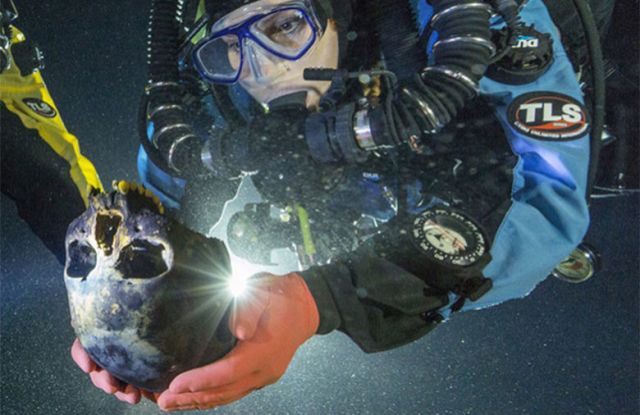
This next discovery is very important. In 2007 the 13,000 year old skull of a female teenager was found in an underwater cave in Mexico and was given the name "Naia" (a clever Greek mythology allusion). DNA tests were done on Naia, and from this it was concluded that the results matched with modern Native Americans. Well, that's just one example, but many other DNA tests from other parts of the continent have come up with the same conclusion. We need to stop denying Native Americans their ancient heritage. It's time to end racist and damaging pseudo-history. Here's a post I wrote a long time ago about the facial reconstruction of an Ancient Peruvian Queen that seemed somewhat relevant.

So for the remainder of this blog post, I'm going to continue pondering the questions when did the first people get here and how did they get here? Neither question has a definite answer, but it's fun to research the possibilities. Perhaps someday archaeology will uncover the truth.   

3 million years ago, way before there were any people anywhere, an isthmus formed that connected North America and South America. This is everyone's favourite isthmus now, Panama.

During the recent Ice Age, about 1.8 million years ago, glacial advances covered up most of the northern extent of the continent. This caused worldwide sea levels to lower as water became locked in the ice sheets. So, vast amounts of land sprung up that are now submerged under higher water levels. One of these land masses was Doggerland, which connected northern Europe and the British Isles. 

But everyone's favourite now-submerged landmass was of course Beringia.


Beringia Refugium 

The theory goes that Beringia was a large shelf between Alaska and Siberia. It was nearly continent-sized. It also wasn't glaciated! This means that there were actually vast grasslands on Beringia capable of supporting herds of animals. This is what gave it the name "beringia refugium" as it was like a refuge for these creatures who could not survive in the glaciated areas. Lots of animals crossed over this land bridge, as well as people. These people migrated across Beringia at least 20,000 years ago and no earlier than 50,000 years ago.


Creatures of Beringia Refugium 
  • Ancestors of the modern horse, which would then go completely extinct until Europeans reintroduced horses.
  • Ancestors of camels, which evolved into llamas.
  • The longhorn bison 
  • Huge beavers 
bEwArE!


The crossing of people across Beringia would have been a leisurely and slow one. People would have moved to follow the big game herds. As mentioned earlier, this crossing could have occurred any time after 50,000 years ago and probably before 25,000 years ago. That answers the very first question posed of how long Native Americans lived here, but how they got here still hasn't completely been answered.

Let me explain, of course the Bering Strait theory is the most credible theory we have and it has lots of scientific proof, but people have also suggested an alternate theory (or one that could have occured after Beringia): water craft.

If you don't think people 25,000 years ago could have invented water craft, think again because the Australian aboriginals got to Australia by boat 50,000 years ago from Africa. 

But now there's a bit of a problem...

Because you see, we still don't know how people crossed into the interior of North America, beyond the glaciers. Some have suggested that a corridor opened between the glaciers originating in the Rocky Mountains and the ones from Hudson's Bay. Others have countered that and said that if a corridor really had opened up, the environment would be too harsh to allow crossing. So here the water craft theory comes in again. 

Clearly, people need to look more into this so that these mysteries can be solved. 

But some how, we know that indigenous people definitely spread as far as South America before 20,000 years ago. We can call this group the Paleo people as they migrated to the Americas during the last glacial episodes. By this time mass extinctions of all the weird animals I mentioned earlier started happening. 

The Archaic Period

Around 9,500 years ago the Archaic Period began. Native people had to start adapting their way of life to a warmer environment. The Archaic Period ended around 2,900 years ago. Around 4000 years ago the Tuniit culture emerged from Greenland and spread across the North American Arctic region.

The Tuniit and the Thule 

The Tuniit (also known as Paleo-eskimos although I'm not going to use that word because 'eskimo' is a derogatory term meaning 'eaters of raw meat') founded what is now known as the Dorset culture. 


The Dorset culture produced many cool ivory carvings like this polar bear thing. 


Unfortunately, the Tuniit were not that great at adapting to the changing environment. The summers were getting unusually warmer and that caused many changes in animal migration patterns. Their culture started to rapidly decline. 

Meanwhile in Alaska, a highly mobile people who could travel in dogsled teams were having no problem at all and were flourishing. These were the Thule. The Thule eventually dominated the Arctic.

Here is a map that shows the Thule spreading all over Arctic Canada:


The Thule became the ancestors of the modern Inuit :) 

So why does this all matter?

 If you've actually read through all of this, you have probably already realized why this may be important. By recognizing that indigenous people have been here for at least 25,000 years, it gives their land claims even more legitimacy and confirms their oral traditions with scientific facts. Meanwhile, European settlers have only been here for around 500 years. 

Alright folks, that's all. Stay tuned for more posts. I have an opinion piece and a book review coming up soon.


Saturday, August 4, 2018

Sp00ky Windigo

Here is a sp00ky Windigo from Algonquian folklore! It's the creature that eats human flesh! Get sp00ked! This painting is probably by Norval Morisseau.


I've been reading "Three Day Road" by Joseph Boyden these days as I've already read his other two popular novels "The Orenda" (fricking amazing) and "Through Black Spruce" (meh). He's a really celebrated Canadian author and one of the only ones who writes historical fiction about indigenous people, so... I'll post a detailed review of his work on my blog and Goodreads account when I'm done (not that anyone would care xD) R.I.P me.
Oh yeah, here's a quote from "Three Day Road" that's really melancholic:
"I realized then that sadness was at the heart of the windigo, a sadness so pure that it shrivelled the human heart and let something else grow in its place. To know that you have desecrated the ones you love, that you have done something so damning out of a greed for life that you have been exiled from your people forever is a hard meal to swallow, much harder to swallow than that first bite of human flesh."
bEwArE!

So fam, stay tuned for a long book review on Joseph Boyden's work. 

Monday, October 9, 2017

The Norse Exploration of North America :o

Are you wondering how I became obsessed with Vikings? Well this post is all about the historical event that made me become obsessed with them. I wrote this back in 2016, but I've decided to revise it and update it with new information straight from the Norse sagas. Plus today is Leif Ericson day, so it seems like a good time to post this. 

 I'm really into the history of the people whom the Norsemen called the "skraelings" AKA the indigenous people of the Americas. But when I started researching the Beothuk people who are native to Newfoundland and Labrador in Canada, I came across information about the Norse explorer Leif Ericson's 'Vinland voyages'. 


First, lets talk a bit about the Beothuk people. As I said before, they were the native people of Newfoundland. While some indigenous people of Canada managed to retain their languages and parts of their culture despite colonialism, the Beothuk are all now all gone :( A little bit of their language still survives though, and you can learn it online although it has no native speakers.  A woman named Shanawdithit, who is considered by historians to have been the last Beothuk, learned some English and was able to write Beothuk words using the Roman alphabet. Thanks to her, and the efforts of a few others of the last Beothuks such as Shawnadithit's aunt Demasduit, we now know some words of the Beothuk language. The word 'Beothuk' itself in their language means 'the people'. Shawnadithit died in 1829 of tuberculosis. 

A portrait of Shawnadithit

FUN FACT: Some European settlers called the Beothuk people the "Red Ochre People" because they covered themselves in red ochre :D . 


Historically, the Beothuks were a semi-nomadic group. There were many subdivisions of the Beothuk based on extended family. These subgroups lived away from each other during the winter. During the summer they would join each other in coastal meeting places to arrange marriages and discuss important things like who the next leader should be. The Beothuk were the some of the first native people of Canada to come into contact with Europeans, along with the Inuit. The Europeans began to settle on the coastal regions, exactly where the summer meeting places once were. As their settlement expanded westward, they began to see the local Beothuk as threats to the settlements. Beothuks were hunted down viciously. The ones who weren't murdered died of tuberculosis or other diseases brought over from Europe. These were introduced by English settlers during the early 1700s. 

Of course, the 1700s were NOT when the settlement of the Americas, or even Canada began. Settlement of Canada was attempted by French explorer Jacques Cartier in the 1500s. It was extremely unsuccessful thanks to the fact that Cartier was so STUPID in the way he dealt with the indigenous Iroquois people. The Iroquois were really nice to him and taught him a cure for scurvy (birch tea). To express his gratitude to them for saving his life he kidnapped their chief and a bunch of other people and killed a lot of people. Later the Iroquois allied with the British and wrecked the French.
Anyway, Cartier's expeditions were quite hilarious failures but talking about them in detail would be for another post. Europeans never really became successful in starting Canada's settlement until another French guy, Samuel De Champlain, came along in 1604. Anyway, the point is, Jacques Cartier is credited for being the first European in Canada. 

The title of "first European in the Americas as a whole" is given to Christopher Columbus who was discovered lost at see by native Taino people of the Caribbean in 1492. 

WHAT I'M TRYING TO SAY IS NEITHER OF THESE PEOPLE DESERVE CREDIT. 

Because the first European in Canada was 

LEIF ERICSON

and the first European in the Americas was 

LEIF ERICSON

another fun fact is that

LEIF ERICSON

wasn't an evil scary genocidal horrible person the way columbus and cartier were.

Leif Ericson, or Leifr Airikson, will always be one of my favourite European explorers. His half-sister Freydis Ericsdottir was cool too. 

 Columbus was known for selling 9 year old girls into sex slavery. Even the Europeans of the time admitted he was a genocidal maniac. The only person who liked him was queen Isabella of Spain. 

And Cartier was just stupid.  No monarch in France liked him because he brought back 'gold' and 'diamonds' from the New World which actually turned out to be pyrite and quartz. That's where the expression 'Canadian Gold' comes from to describe something worthless.

He ended France's interest in settling Canada for almost a century. 

I'm sure Eric the Red's son was better than that. 

Anyway, the remainder of this post shall be dedicated to talking about the exciting Norse exploration of North America, which occurred 500 YEARS BEFORE COLUMBUS. 

And if any of you still believe that this is pseudo-historical nonsense, well, please go to L'anse aux Meadows in Newfoundland and see that there are indeed Viking settlements there. The Norse called that little hamlet of houses "leifsbudir" after Leif of course!
You can book a room in Valhalla lodge (named after the glorious afterlife that Viking warriors went to) in the fabled Vinland and stalk all the skraelings and Vikings there. You can even watch some cheesy white people dressed as Vikings do cool sword fighting reenactments while you're there. I haven't had the pleasure of going to northern Newfoundland myself. However, I have personally met one of the reenactment groups who perform there. THEY WERE COOL. I WISH I COULD FIND THE PICTURES I TOOK WITH THEM BUT I CAN'T :( . 

Sometimes I write fanfictions about Vikings. 

Perhaps I should start calling them the Norsemen instead of Vikings, as Norsemen is what they called themselves. It means "North men" obviously. Viking was a word of the time meaning raider or explorer. It was their occupation not ethnicity. 

Early Settlements in Iceland

The Norse culture originated in the southern Danish peninsula in the 790s. From this time until the Norman conquest of England in 1066, northern Europe was in the period of time known as the Viking age. 

Iceland was settled by the Norsemen in about 870 AD. However, Gaelic monks and other  people had settled the island and established monasteries a bit before that. There weren't any indigenous people on the island, so Icelanders are not guilty of committing mass genocide or anything like that. I mean sure, some Greenlandic Inuit may have visited the island before Europeans, but they never stayed and such an event was never recorded. Iceland is European. It is the BEST European country. 

 NORSEMEN ARE COOLER THAN IRISH MONKS THOUGH. I'm glad they left when they saw the Norsemen or else they'd "get rekt" like the monasteries of Lindisfarne, where the very first Viking raid happened.

"Protect us, O Lord, from the wrath of the Northmen" 

~ a random monk from Lindisfarne before a Viking killed him

The Norse really needed more farmland so they eventually discovered Iceland, the land of Ice and Fire. Once it was settled they wanted even more land. 

SO THEY FOUND 

Grønland 

WHICH HAD NATIVE INUIT PEOPLE LIVING THERE 

Greenland was settled by Erik the Red, also known as Erik Thorvaldsson, which means his dad's name was Thorvald. That's how these patriarchal Norse last names work. And you guessed it, Erik the Red was the father of Leif Eriksson or Ericson or Aerikson or however you want to spell it there are like 5 ways to spell that last name. His daughter's last name was Eriksdottir. Erik the Red wasn't the first European in Greenland but he was the first to actually settle it.

It's like how Samuel De Champlain stole Jacques Cartier's title as the Father of New France. 


Erik the Red, called that because of his epic red beard and hair, settled Greenland. The Norsemen called it Grønland. BUT WE MUST CALL IT KALAALIT NUNAAT BECAUSE IT RIGHTFULLY BELONGS TO THE INUIT. 

Oh well, if the indigneous people take back their land I imagine that place will be a territorial dispute. Perhaps they can share Greenland to play skraelings vs. vikings with each other ad infinitum

Erik the Red went to Greenland after he was convicted of manslaughter and banished from Norway. Greenlanders considered him a hero and stuff. Cool. 

He slept around a lot according to sagas and soon had a son named Leif Erikson or Leif the Lucky.
He also had an illegitimate daughter named Freydis Eriksdottir. Freydis sounds liked my own name, Freya, doesn't it? Freya was a Norse goddess of love and beauty. Like me, she had two pet cats and admired the heroic dead, ruling the afterlife of Valhalla for fallen warriors. Her name translates to "noblewoman" or "queen". But before any Scandinavian people accuse me of sacrilege by taking on a goddess' name, I have to say that my parents had no idea that Freya was a Norse goddess before they named me. According to them, the name means 'beloved' in Persian. 

So I suppose you can guess where the history goes from here. Leif Ericson was the first white person to see the Americas minus Greenland right? wrong. 

The first white person to see the Americas was the Icelander Bjarni Herjolfsson in 986 A.D. He saw the distant New World when his ship was blown off course. He saw three different new lands through the icy mist. The Norse saw to it that they were named "Helluland", "Markland" and "Vinland" which are believed to have been Baffin island, Labrador, and Newfoundland respectively. 

Bjarni's tails inspired Leif to sail westward to these cool new islands. He bought Bjarni's own ship and set sail, seeking VINLAND. 

What is Vinland? 

In simple terms, it was the name the Norse gave to northern Newfoundland. But other historians debate that the Norse explorers went southward and eventually discovered a different land which was better and called it Vinland. I think this debate is stupid as there is no evidence for it. Vinland is certainly a lot more than just a name for a measly Norse settlement. It was an idea of paradise from Norse mythology. The 'vin' in Vinland has been translated to mean either "wine" or "meadow/pasture". The latter translation makes a lot more sense to me, as the Norse were always looking for more good farmland. There wasn't much in northern Europe. It only makes sense for an ideal Norse mythological paradise to contain endless farmland. Do you think Leif the Lucky was really lucky when he found that barren, rocky tip of an island teeming with skraelings? Was it really something that deserved to be call Vinland? 

It's like the Spanish idea of "El Dorado". 

"We Spaniards have a disease of the heart that can 
only be cured by gold." 

~ Hernan Cortes, conqueror of the Aztec empire 

Cortes is only second to Columbus on the list-of-historical-figures-I-would-have-murdered-for-fun. 

Vinland was also the name of the ship that Freydis Eiriksdottir sailed to Leifsbudir on the second Norse expedition to the Americas. The crew had both Greenlanders and Icelanders, but Leif didn't come.

The sagas claim the Norse were mostly lumberjacks when they visited the Americas.
 They also traded with the skraelings aka the Red Ochre people. But don't worry, the Norse didn't bring diseases. They were considered clean and well groomed by other Europeans. That is why white women always fell for those vain Vikings. Would you rather have the North-man who you can go on raids to burn down christian monasteries with or the misogynistic catholic scrub who never bathes? Please don't ask Queen Isabella of Spain this question. 

 The Vikings were also way less sexist than Christians and there were just as many female raiders as male ones. The Norse also had pretty hair and were the first Europeans to use combs. 
Exceptionally well preserved Viking combs from a site in Russia. Many Vikings settled in and assimilated into Russian culture.

Some Norse combs also have really pretty designs carved on their handles. 

So they traded with the natives but never actually settled there. But perhaps they had the intention of doing so. Why else would they have established Leifsbudir? 

Why the Vikings left their settlement in Newfoundland: Two possible reasons why


1: Conflict with the natives

There have been accounts that say that the Vikings treated the indigenous people well. They didn't pillage, rape, or kill them. They merely traded. However, there have been also accounts that say that the Vikings did exactly the opposite of that and were as brutal, savage, and genocidal as any other European explorers were. The Beothuk and other indigenous people of the area may have fought and expelled the Vikings. Some people suggest that the Vikings tried giving the natives cow's milk. There is no proof for that but it's a funny story: 

Most Native Americans are lactose intolerant (I have a really weird sense of humor. Sorry I laughed really hard when I typed that for some reason.) The indigenous people started having whatever problems lactose intolerant people have when you give them creamy, thick, raw, stinky milk from the plump udders of Norwegian cows. 

Please, don't start randomly going up to Native American people and asking them if they are lactose intolerant. 


They were colonist cows though so alternately they might have been undernourished tiny cows who can't really produce good quality milk. The indigenous people thought they were being posioned, and so launched an attack on the weird pale blue-eyed aliens who had given them the elixir.


 In my opinion, if conflict with the natives was the reason why the Vikings abandoned Leifsbudir, it probably didn't involve lactose intolerance. It was probably just a war started after the Norse might have done something really Cartier-level idiotic. The good part is that if the Vikings were genocidal and evil, at least they were deported. Who wants to speak Old Norse and have their country capital be Leifsbudir, which may have one day become a sprawling metropolis of over 100,000 people instead of a handful of rugged Norsemen, who knows? 


2: Conflict among themselves


The Vikings might have left North America not because of the natives, but because of conflict with each other. The Greenlanders and Icelanders in Freydis Eriksdottir's crew didn't have much of a reason to like each other.After restlessly dwelling in Leifsbudir, they all might have gone mad, surrounded by endless skraeling-filled forest. Arguments broke out between the Icelandic and Greenlandic crew. Freydis herself was an ill-tempered Greenlander. A battle started in which both sides may have massacred each other. Whoever survived left Vinland forever. This would explain why only one ship returned back from the voyage. Originally there were supposed to be two, the Vinland and a smaller one. 


But no one really knows why they left.


Reasons why you might still dislike the Vikings 


and Leif Ericson:


1) HE CONVERTED TO ChRisTianiTY in his later days *gAsps*

By this time, Christianity was spreading in the Viking world like a plague. Leif converted on a trip to Iceland. :(

2) It's hard to say whether he was violent and genocidal or not. The sagas are difficult, contradictory, even. Did he merely trade with the Beothuk, or try to exterminate them? We may never know.

3) The Vikings had shown their greed for land by taking over Greenland. Maybe they wanted to do the same with Newfoundland?

4) If the intention of the Vikings was to take over Newfoundland, then the only thing that made them unsuccessful was the lack of biological warfare. 


5) 
The Norse term "skraeling" which they called the indigenous could be taken as highly offensive. It might have meant "savage". The modern Icelandic word "skraelingi" has a similar meaning.

What you can do now that you are obsessed with the Vikings and probably will be for at least a week 

Historical fiction books and tv shows 

By the way, if you read about any culture enough you will become obsessed with it. It's kinda inevitable, so don't feel bad if you now find yourself in a Viking obsession phase. You can indulge in Rick Riordan's new series on Norse mythology, or a very similar series called "The Blackwell Pages" by Kelly Armstrong and Melissa Marr. I've met both authors in person at a book convention. They are awesome and the Blackwell Pages series is amazing, probably better than the Riordan Norse mythology series although less cool than the Greco-Roman series he has written. Also check out "Sword Song" by Rosemary Sutcliffe , a story about a boy named Bjarni banished from Norway for manslaughter (how similar to the Fate of Erik the Red!) who becomes a mercenary. There is also a female part-skraeling character ;D . Check out "The Dream Carvers" and "Eiriksdottir" by Joan Clark and of course the Irish-Canadian tv series "The Vikings".

and remember, Scandinavian folk music is very good so you might want to make a new dank mixtape: 


That's all. 



Monday, June 26, 2017

Canada 150 DOs and DON'Ts


Hi there guys! Sorry I haven't updated the blog much recently. Sorry that all my posts begin with "Sorry I haven't updated the blog much recently". Well now that the summer vacation is almost here, I'm making plans of what to do with my life when there is no school to look forward to (ye so I'm lowkey a nerd). My grandparents have also recently come to visit from India. I really want to show them what Canada is all about by taking them to some iconic historical sites and all, and of course a huge part of that will be telling them stuff about Canada's indigenous people. 

Alright so it just so happens that Canada's 150th anniversary of confederation is coming up. I'm probably the least patriotic person you will ever meet and I actually hate the governments of all countries (though I love all their cultures but more on that later), but even I couldn't help but feel a little excited. I mean, it's a once in a lifetime event. The federal government is going to spend half a billion dollars on it and there will be discounts everywhere to visit museums, historic sites, etc. For a Seeker of High Culture like me, that sounds pretty terrific. It would just be such a waste to stay at home and rant on my blog about how Canada is guilty of genocide and should be using all that money to pay reparations while it is instead flaunting everything it stole from indigenous people. So I just wanted to say that there's a good and a bad way to approach this dilemma. I bet you no one who follows this blog likes the idea of Canada 150, but my disciples please remember that we must learn to make the most of even the worst situations. So, read on. 


DO:
  • Get educated on what this celebration is all about if you don't know much about the history of confederation already. Yes I'm talking about grade 7 history when you learned all about John A. MacDonald's vision of uniting British North American colonies a mari usque ad mare. Please don't be one of those people who are like all into the celebration but don't know what the Charlottetown Conference was. Please. We need to be better than some Americans are on July 4th. 

  • View the day not as a measure of how far we've come as a nation, but how far we still have to go. 

  • Remember that patriotism is stupid. No exceptions. Not even Mexican patriotism even though Mexico>Life. Oops. 

  • Remember that Canada is what it is because of the genocide of First Nations people.

  • Take advantage of the discounts to popular tourist attractions. See if you qualify for a FREE Discovery Pass http://www.commandesparcs-parksorders.ca/webapp/wcs/stores/servlet/ProductDisplay?storeId=22953&urlLangId=-1&productId=524528 . 

DON'T:

  • Skip reading this brilliant article by Pamela Palmeter, Chair in Indigenous Governance at Ryerson university: 

Canada 150 is a celebration of Indigenous genocide

This year, the federal government plans to spend half a billion dollars on events marking Canada's 150th anniversary, prompting a great deal of debate about its historical treatment of Indigenous peoples. The majority of Canadians don't have all the facts about that, while First Nations continue to live the crisis-level effects of that legacy. Perhaps Canada should cancel its celebrations and undertake the hard work necessary to make amends.

MARCH 29, 2017
 
5:43 PM


  • Say anything that would imply you think Canada is in any way "better" than other countries. 
  • Do anything degenerate. Like actually, I think you know what I mean by now and I can trust you now, right? I can unleash you upon the world now with no regrets. 
Alright so now that that's out of the way I want to take a few more moments to just talk about my life and what my plans are for the summer. I want to talk about some novels I will be working on. You may have heard a bit about them if you've been checking out my writing page which u can click here to see. One of them is about two communists who time travel back to the Aztec civilization and try to introduce their ideals to the MexiCa WorLd. It also doubles as a bildungsroman tale of a Mexica teenager who is trying to discover her views on politics, love, and all the rest of that sort of stuff that we try to figure out at this age. The other one I'll be working on is a sequel to the book I wrote that won NaNoWriMo 2016. If you want to read that award winning book, go to the writing page of this blog or click here. It's about a huge cultural revolution that occurs and basically, I don't want to spoil it. But the sequel I will be writing will be on what happens after the revolution. The protagonists are trying to establish a World Government, kinda like the United Nations except that it actually has power. This way leaders will make decisions keeping the good of the citizens of the whole world in mind instead of just of their nation. I'm an anarchist as far as I don't believe in countries, but the world is my country and I would be patriotic to a government that actually benefits the world. 

Other random af stuff I'll be doing over the summer: 
  • Learning to play the harmonica so that I can perform a duet with Vickyish. 
  • Learning to play the bansuri (Indian bamboo flute) 
  • Practicing playing the regular flute 
  • Practicing playing the recorder even though recorders are gross 
  • Practicing playing the trumpet 
  • Making lots of art, possibly even venture into making a comic book. Who knows? 
  • Celebrating my birthday
  • Writing novels
  • "celebrating" Canada 150 ;D 
  • some activism related to aboriginal rights (I'll keep you posted on this for sure so that you know I'm being legit.) 
  • updating this blog regularly 
  • Working at a summer job which will be tutoring people who are learning English O_o 
  • Studying math, physics, chemistry and biology in advance so that I don't die in grade 11
  • Possibly studying history and philosophy for the fun of it 
  • Reading a bunch of random af books. Possibly just anything I can get my hands on, including everything from degenerate YA fiction to "The Republic" by Plato. I'm not picky when it comes to books and I'll post some of my Goodreads reviews if any of you are interested. Ideally I would want to finish reading the Mexica Movement's recommended book list, but they are a bit hard to find. It doesn't help that a few of the books on that list are out of print. About time they wrote a compact manifesto, not that I wouldn't want to read everything else as well. 
Alright well that's it. 

have an awesome summer, everyone!